
How Much Does a Concrete Driveway Cost on Long Island in 2026?
A new concrete driveway on Long Island costs between $8 and $16 per square foot installed in 2026. For a typical two-car driveway (around 600 square feet), that works out to $4,800 to $9600 for a plain concrete pour. Adding stamped patterns, decorative borders, thicker slabs, or rebar reinforcement pushes the total higher. Removing a narrow, straight existing driveway with good truck access pulls it lower.
This article breaks down exactly what moves that price, so you know what a fair bid looks like before any contractor rings your doorbell.
What's Actually in That Per-Square-Foot Price
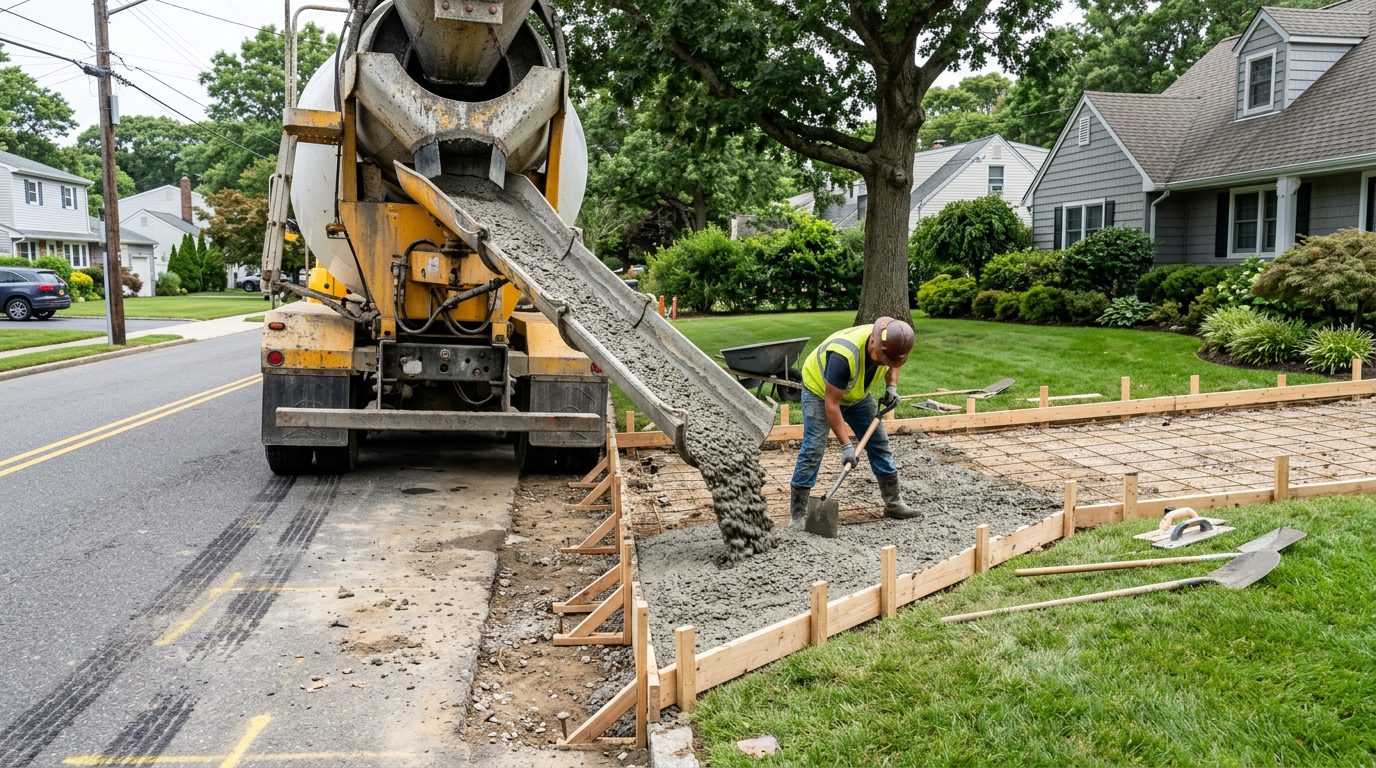
When a contractor quotes you "$8-$10 a square foot," that number usually covers:
· Subgrade prep (grading the ground, removing loose material, compacting a gravel base)
· Forming (the wooden frames that shape the slab)
· Concrete material (typically 4,000 PSI mix for driveways on Long Island)
· Placement and finishing (pouring, leveling, troweling)
· Curing support (initial protection as the slab sets)
· Cleanup and haul-away of debris
It usually does not cover:
· Permit fees
· Demolition of an existing paved surface (often $4 to $6 per sq ft extra or a Lumpsum for a Dumpster)
· Reinforcement (adds $1 to $2 per sq ft)
· Decorative finishes like stamping, coloring, or exposed aggregate
· Heated driveway systems
· Landscaping or curb repair after the pour
If a bid looks suspiciously cheap, check whether items on this second list were excluded. Many are.
How Long Island Weather Affects the Price
Freeze-thaw cycles matter more here than most homeowners realize. A driveway poured in Suffolk or Nassau sees the slab expand and contract through every winter.
· Thicker slabs cost more but last longer. A 4-inch slab is the residential minimum. On Long Island, many contractors recommend 5 or 6 inches, particularly if you park a heavier vehicle (pickup, SUV, work van).
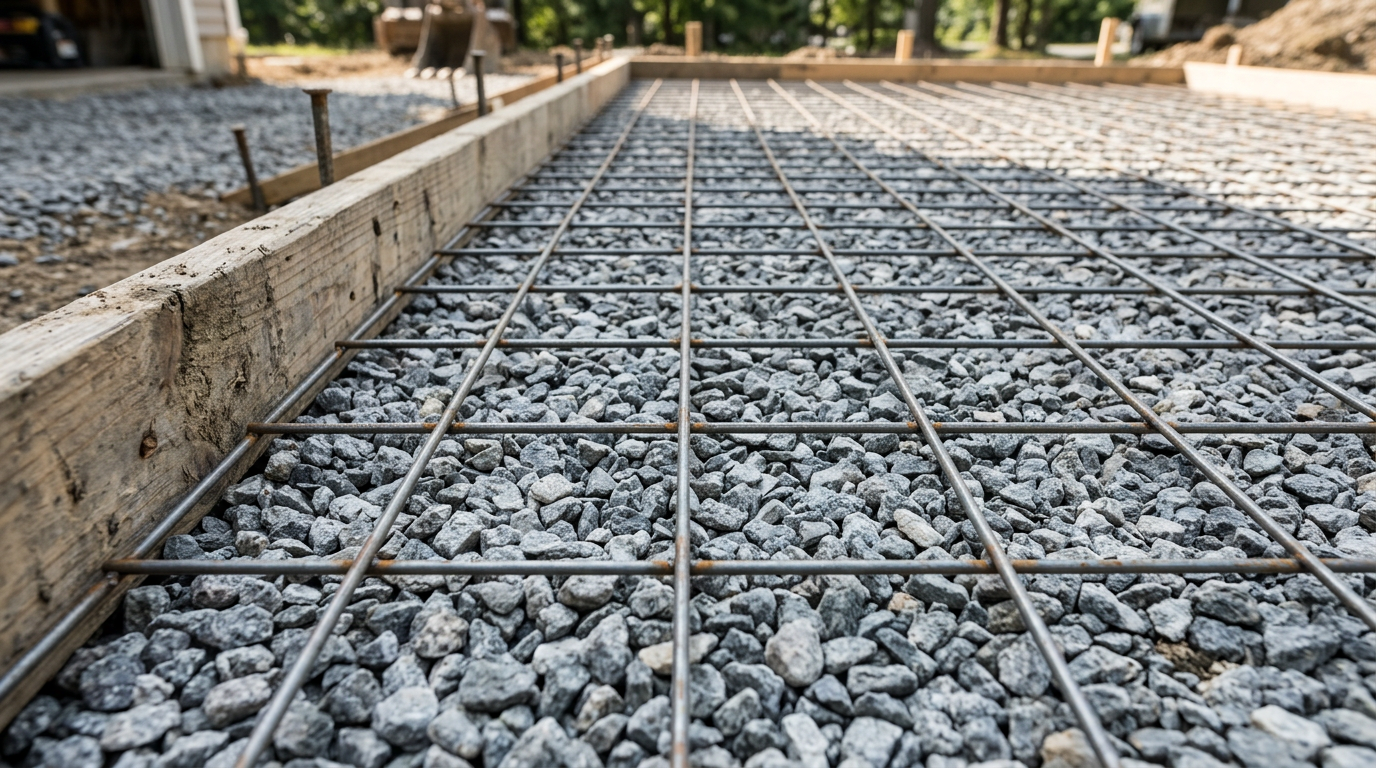
· Rebar or Wire mesh is worth it. Unreinforced concrete cracks sooner under LI's freeze-thaw pattern. Reinforcement adds $1 to $2 per sq ft but typically adds 10+ years of usable life.
· Air-entrained concrete is the standard on Long Island. A proper mix handles freeze-thaw without surface spalling. If a contractor doesn't mention it, ask why not.
· Pouring season affects quality. March through November is the safe window. Pours below 40°F or above 90°F require special handling that adds cost. Many contractors refuse to pour in January or February.
On the South Shore (Bay Shore, Babylon, Massapequa, Oceanside, Long Beach), coastal humidity and salt exposure mean proper sealing matters more. Budget $1 to $2 per sq ft every 3 to 5 years for resealing.
What Moves the Price Up
The biggest cost drivers, in rough order:
1. Decorative finishes. Stamped concrete adds $6 to $12 per sq ft over plain. Exposed aggregate adds $3 to $8. Colored or stained finishes add $2 to $6. Borders add $4 to $10 per linear foot. (Color may affect pricing drastically)
2. Thicker slabs. Going from 4 inches to 6 inches adds roughly $2 per sq ft.
3. Reinforcement. A rebar grid adds $1.50 to $2 per sq ft and most times is not necessary. Wire mesh is cheaper and most common.
4. Demolition. Removing an existing asphalt or concrete driveway typically runs $4 to $6 per sq ft, depending on thickness.
5. Difficult access. If the concrete truck can't back up close, a pump truck is needed. Pump truck alone is $600 to $1,500 for one visit. It is not advised for a very long driveway to be poured by wheelbarrow. It will take a lot of man power, and it will be much slower which can affect the quality of concrete.
6. Drainage work. French drains, trench drains, or grading to handle runoff can add $500 to $3,000.
7. Curves and custom shapes. A kidney-shaped or curved driveway takes more forming and finishing time than a straight rectangle.
What Moves the Price Down
Not everything pushes the total up. The following can bring the per-square-foot rate toward the low end:
· Clean, flat subgrade that doesn't need regrading
· No existing surface to demolish (first-time driveway)
· Standard rectangular shape with straight runs
· Easy truck access — no tight backyards, narrow side yards, or overhead wires
· Pouring in the middle of the season (May through September) when contractor schedules have slack
· Bundling jobs — if you're also doing a walkway or patio at the same time, many contractors reduce the unit rate
Permits and Why They Matter for Your Total Cost
Every town on Long Island handles driveway permits differently. In most cases you'll need:
· A building permit for new construction or full replacement (typically $50 to $300)
· Possibly a curb cut permit if you're widening where the driveway meets the street ($100 to $600)
· A stormwater runoff plan in some jurisdictions
The Town of Brookhaven, Town of Islip, Town of Huntington, and Town of Hempstead each have different thresholds. Some require a permit only if you're widening or changing the location; others require one for any replacement.
A good contractor handles the permit for you and includes the fee in the bid. If a contractor says "you don't need a permit" without checking, verify with your town's building department yourself. Pouring without a required permit becomes a real problem when you later sell the house.
For the full permit breakdown by town, see the guide on concrete driveway permits in Suffolk and Nassau County.
Common Mistakes That Cost You Money
Problems real homeowners run into:
8. Taking the lowest bid without reading the scope. The cheapest bid usually leaves out items (rebar, permit, haul-away, proper subgrade prep) that the others include. You find out after the pour when you're asked to pay extra.
9. Skipping Reinforcement. Save $1,200 on a 600 sq ft driveway, lose it in 5 years when the slab cracks and needs replacement.
10. Pouring too thin. A 3-inch driveway exists. It shouldn't. 4 inches is the minimum. 5 is safer on Long Island.
11. No expansion joints. Without proper joints every 8 to 10 feet, the slab cracks where you don't want it to.
12. Pouring over frozen or wet subgrade. In rushed jobs, contractors pour over conditions that guarantee cracking. If you see ice or standing water under the forms the day of the pour, stop the job.
13. Paying full price upfront. A reasonable schedule is 30% to start, 40% at pour, 30% on completion. Anyone demanding full payment before the work is done is a red flag.
Estimator's Note
Estimator's note: On jobs I've bid in Smithtown and Commack, the difference between an $8-per-sq-ft bid and a $16-per-sq-ft bid usually comes down to four line items: size, reinforcement, slab thickness, and haul-away. When those three line up, the rest of the price usually falls into place. When they don't, the cheaper bid gets expensive later.
Realistic Timeline
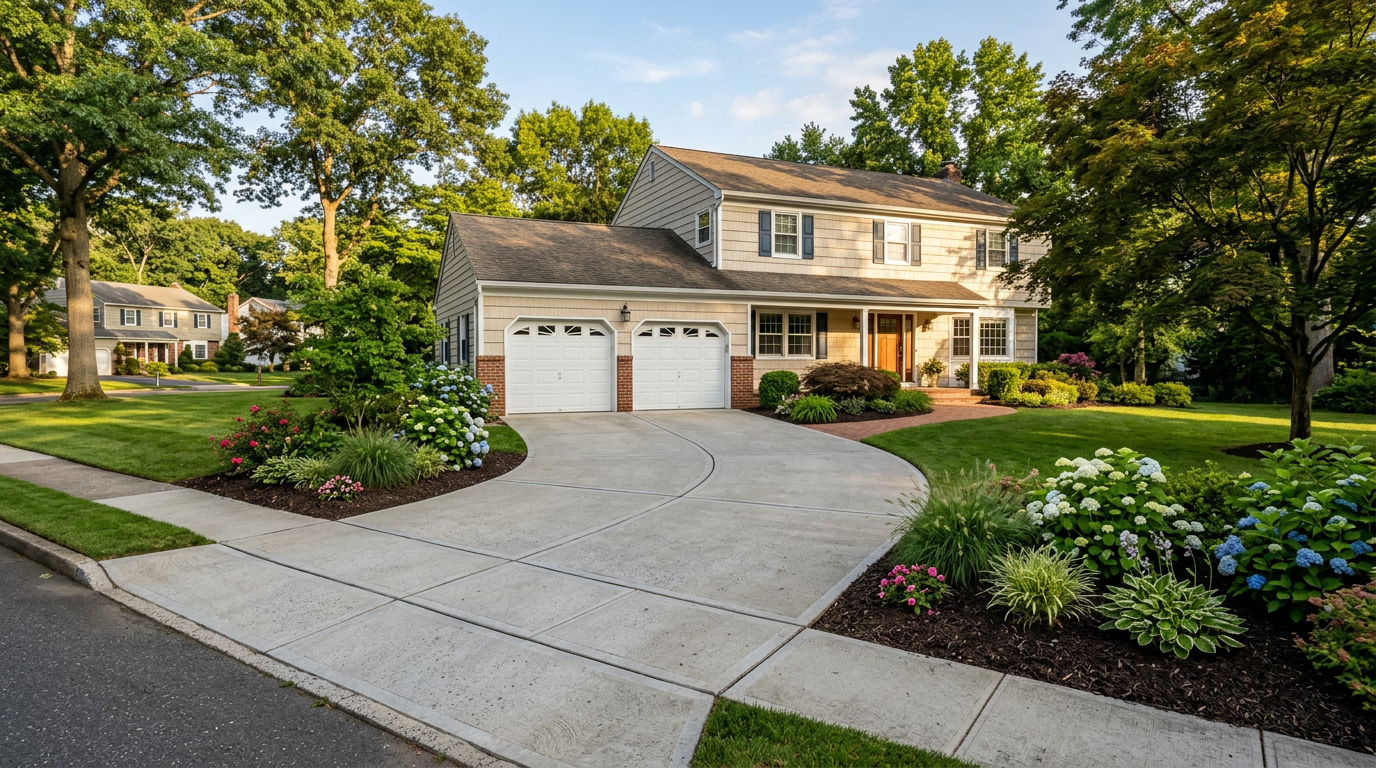
A straightforward concrete driveway replacement on Long Island, from first call to drivable surface, runs about 2 to 3 weeks:
· Week 1: Estimate and scope confirmation - Homeowner to Submit Permit application (timing varies by town) (If needed)
· Week 2: Demo of existing driveway (if needed), Subgrade prep and forming, Pour and finishing
· Week 3: Curing — no cars for 3-5 days, no heavy vehicles for 28 days
Considering Asphalt Instead?
Concrete lasts about twice as long as asphalt but costs more up front. Asphalt is easier to repair in sections and drivable in 24 to 72 hours. If you're weighing both materials, see concrete vs. asphalt driveway for a Long Island home.
The Bottom Line
A concrete driveway on Long Island in 2026 runs $8 to $16 per square foot installed, depending on thickness, reinforcement, finish, and site conditions. A fair bid lines up with proper thickness, proper reinforcement, a permit when needed, and a realistic timeline. If any of those are missing, the price isn't really the price.
If you want a free estimate written by a professional concrete estimator before any contractor comes to your house, request one here.